
A blocked drain can be cleared without knowing why it blocked. That is fine once. When the same drain blocks again three months later, or the whole house starts draining slowly, clearing it blind is money spent on a symptom. A CCTV drain inspection is how a plumber finds the cause.
This guide explains what a drain camera does, when it is worth paying for one in Sydney, what you should be handed afterwards and what it costs. If your drains are backing up right now, start with our blocked drain emergency page instead.
What a CCTV drain inspection is
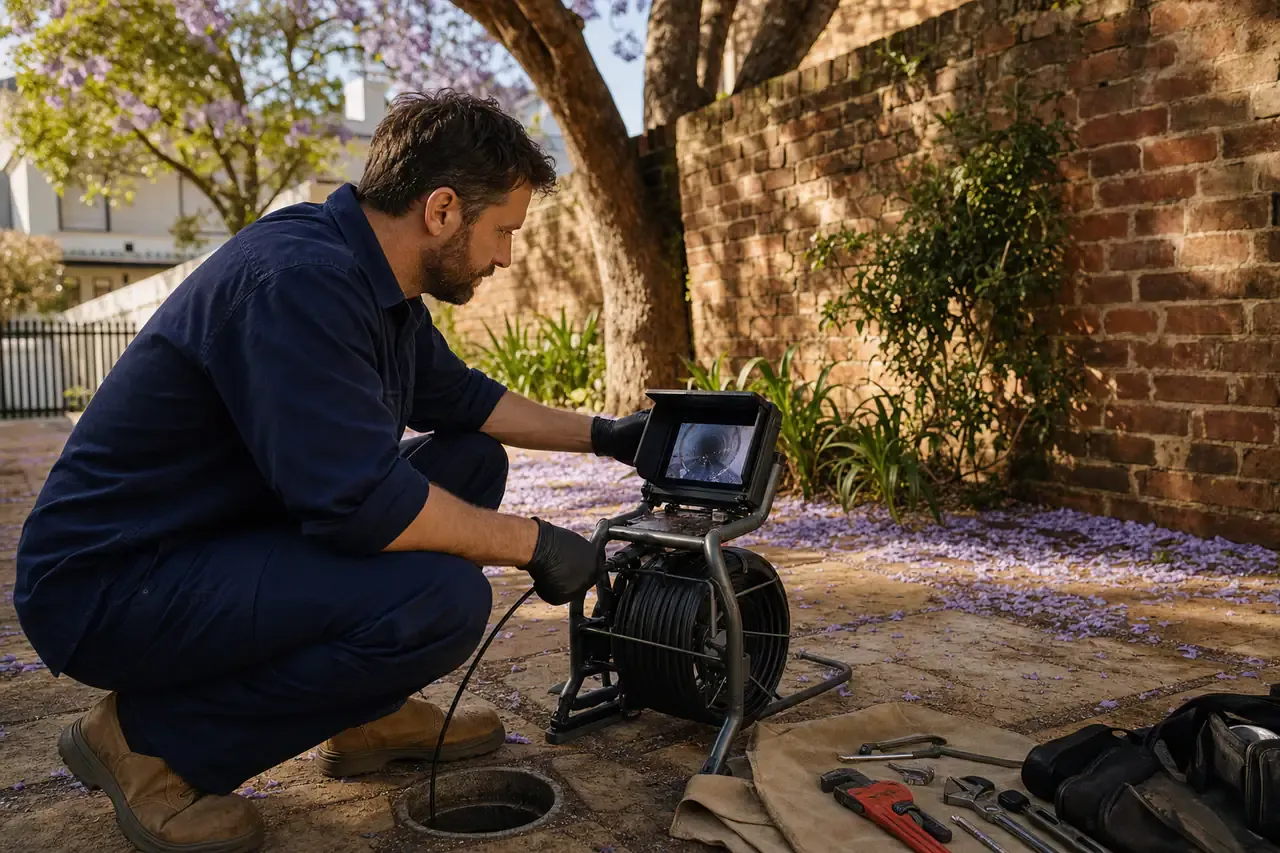
A small waterproof camera on the end of a flexible rod is fed into the drain through an inspection opening or a removed fixture. It sends a picture back to a screen as it travels, and the plumber records the whole run. A counter shows how far the camera has gone, and a locator carried over the ground above picks up a signal from the camera head, so the position and depth of anything it finds can be marked on the surface.
The result is evidence rather than opinion. You can watch the footage yourself and see the roots, the crack or the broken joint.
When it is worth having one
- A drain that keeps blocking. A line that blocks more than once has something wrong with it. Clearing it again will not change that.
- Several fixtures affected at once. If the shower gurgles when the toilet is flushed, the problem is in the main line, not one trap. Our post on the signs of a blocked sewer line lists the warnings.
- A sewage smell or a wet patch in the garden with no other explanation.
- Before you buy an older house. A building inspection does not look inside the sewer. In suburbs full of clay pipes and big trees, a camera inspection before exchange is cheap insurance.
- Before relining or digging. Nobody should quote to reline or replace a pipe they have not looked inside.
- A dispute over a shared drain. Footage that shows where the blockage sits settles who is responsible for it.
One blockage that clears and stays clear does not need a camera. A plumber who insists on one for a simple hair blockage in a shower is selling, not diagnosing.
What the camera finds in Sydney drains
Tree roots. The most common finding by far. Older Sydney homes drain through short lengths of clay pipe with mortar joints, and roots get in at the joints. On screen they look like a white or brown mass hanging into the pipe.
Cracks and collapsed pipe. In the clay-soil suburbs of Western Sydney the ground moves with the weather and pipes crack with it. Our guide to clay soil pipe damage explains why.
Displaced joints. Two lengths of pipe that no longer line up. Paper and waste catch on the step.
Sags. A section that has sunk and holds water. The camera goes under water and comes out again further along.
Grease, scale and foreign objects. Fat from kitchen sinks, mineral build-up in old cast iron, and the occasional toy.
What you should be handed afterwards
A proper inspection leaves you with three things:
- The recording. The full run, not a few stills.
- A written report that lists each fault, how far along the pipe it is and how deep, with the position marked on the ground or on a sketch.
- Options and prices. What can be cleared, what needs repair, and what each would cost.
If all you get is a verbal summary and a quote for the most expensive option, ask for the footage. It is your drain and you paid for the inspection.
What happens next
What the camera shows decides the repair:
| What it finds | Usual fix | Typical price in Sydney |
|---|---|---|
| Soft blockage, grease or paper | Mechanical clearing | $150-400 |
| Heavy or distant blockage | Hydro-jetting | $350-650 |
| Tree roots in the joints | Root cutting | $400-800 |
| Cracked pipe, joints still in line | Relining, with no digging | $400-650 per metre |
| Collapsed or badly displaced pipe | Dig up and replace the section | Quoted on site |
Root cutting buys time, usually a year or two, because the roots grow back through the same joint. Relining seals the joint for good. The footage is what lets you choose between them with your eyes open.
Whose drain is it?
You own the drains on your property and the line that carries waste to the sewer main, up to the point where it joins. The main itself belongs to Sydney Water. If the camera shows the blockage is in the main, it is theirs to clear: report it on 13 20 90. Sydney Water explains who is responsible for a wastewater blockage on its website.
It also keeps a sewer service diagram for most properties, showing where the private drains run. It is worth having before an inspection on a house you are thinking of buying.
What it costs
A standalone CCTV drain inspection in Sydney is typically $220-350, with the recording and the report. When the camera is used while clearing a blocked drain, it is normally part of that job. Either way, ask for the price and what it includes before the camera goes in. Our pricing page lists the reference ranges for every common drain job.