
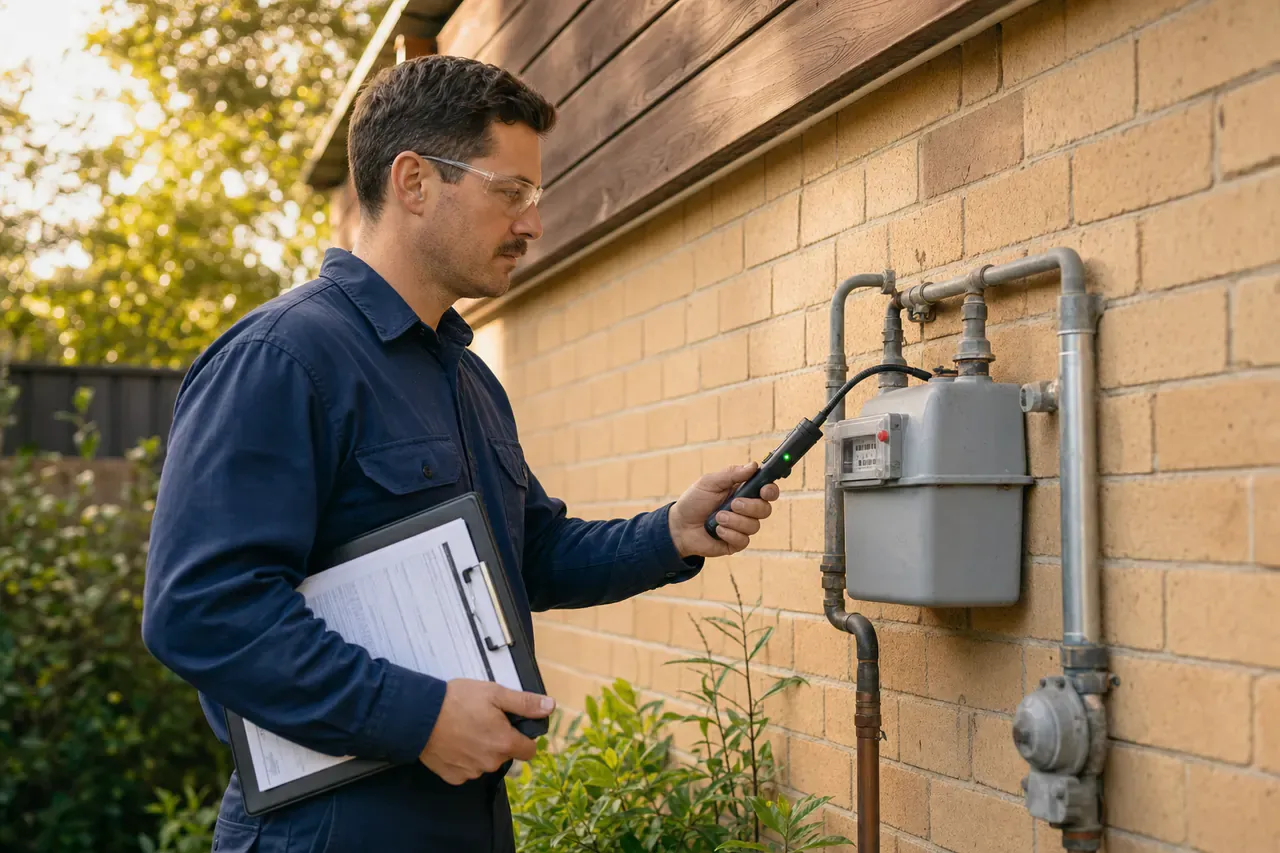
Gas fitting in Sydney is one of the few jobs around the house that the law says you cannot do yourself, and that not every plumber can do either. A gas fitter is paid for more than joining a pipe to an appliance: they are paid to prove the installation is safe and to put their licence number on a certificate that says so.
This guide covers what a licensed gas fitter checks on every job, the paperwork you should be handed, what it costs, and the signs that your gas needs attention. If you need the work done, our gas fitting plumber in Sydney page has the details.
If you can smell gas right now, stop reading. Leave the building and ring Jemena on 131 909 from outside. Our guide to what to do in a gas leak has every step.
Who can do gas fitting in NSW
Gas fitting is licensed separately from plumbing. The licence is issued by NSW Fair Trading, and it is an offence for anyone without one to connect, disconnect or alter a gas pipe or a gas appliance. A plumber who holds both licences is usually called a gas plumber, and that is who you want for jobs that involve water and gas together, such as a gas hot water system.
Before the work starts, ask for the licence number and check it on the NSW Fair Trading register. The check takes a minute and shows whether the licence is current and whether it covers gas fitting. Our post on how to verify a licensed plumber walks through it.
The seven things a gas fitter checks on every job
1. The gas type matches the appliance. Sydney homes run on natural gas from the street or on bottled LPG. The two burn differently, and an appliance set up for one will not run safely on the other without being converted.
2. The pipe can carry the load. Every appliance added to a house draws more gas. The gas fitter adds up what the cooktop, the heater and the hot water system need together and checks that the pipe from the meter is big enough. An undersized pipe is why a heater sometimes drops out when the hot water starts.
3. Each appliance has its own shut-off valve. It has to be easy to reach, so the appliance can be isolated for a repair without turning off the whole house.
4. Clearances and fixings. Cooktops need set distances from walls, cupboards and the rangehood above. A freestanding cooker on a flexible hose needs a restraint, so the hose can never take the weight of the cooker when it is pulled out for cleaning.
5. Ventilation and flues. Gas needs air to burn cleanly, and the exhaust has to go somewhere. Flues are checked for the right fall, length and clearance from windows. A heater with no flue needs permanent ventilation and must not go in a bedroom or a bathroom.
6. A leak test. With everything connected, the installation is pressure-tested with a gauge. If the pressure holds, it is tight. A soapy-water check on each joint finds the one that is not.
7. The flame. The last check is the simplest: light it. A steady blue flame means the burner is getting the right mix of gas and air. A yellow or orange flame means it is not, and that is how carbon monoxide is made.
The paperwork you should be handed
When the job is finished, the gas fitter gives you a certificate of compliance for the work and fixes a compliance plate near the meter or the appliance. Both carry the licence number of the person who did the work.
Keep the certificate with your house papers. An insurer may ask for it after a fire or a leak, a buyer’s building inspector may ask for it when you sell, and it is your proof that the work was done by someone licensed to do it. No certificate usually means no licence.
Signs your gas appliances need a gas plumber
- A yellow or orange flame on a cooktop, heater or hot water unit that used to burn blue
- Soot or brown staining around a burner, a heater or a flue
- A pilot light that keeps going out
- A smell of gas near an appliance, even a faint one that comes and goes
- Headaches, dizziness or tiredness that ease when you leave the house — a warning sign of carbon monoxide
- A hissing sound near the meter or a gas pipe
- A gas bill that has risen with no change in how you use gas
The last one is worth checking yourself. Turn every gas appliance off, then look at the gas meter. If the dial is still moving, gas is going somewhere it should not.
What gas fitting costs in Sydney
| Job | Typical price in Sydney |
|---|---|
| Connecting a cooktop or oven to an existing gas point | $180-450 |
| A new gas point or a line extension | $350-900 |
| Gas line to a BBQ or outdoor kitchen | $400-1,100 |
| Like-for-like gas hot water system, installed | $1,200-3,500 |
| Changing from electric to gas hot water | $1,800-4,500 |
| Gas safety inspection of every appliance | $180-280 |
| Finding and repairing a gas leak | $250-1,200 |
These are 2026 reference ranges and include the compliance certificate. The length of the pipe run and how hard it is to reach move the price more than anything else. Ask for the quote in writing before the work starts.
Planned beats urgent
Most gas emergencies start as something small that was left: a flame that turned yellow last winter, a faint smell behind the oven, a heater that has not been serviced since it was installed. A gas safety inspection costs less than the first hour of most emergency call-outs.
If something does go wrong, our gas leak emergency plumbers work across Sydney 24 hours a day. For planned work, see our gas plumber Sydney page or send the quote form.