
Skip to content

Sydney Emergency Plumbing

Emergency Hot Water Repair Sydney

No hot water? Local Sydney plumbers carrying common Rheem and Rinnai parts — same-day repair on most systems, like-for-like replacement within 24 hours when needed.

Call 0468 022 662 Get a free quote
  • Plumbers experienced with Rheem and Rinnai systems
  • Common replacement parts (thermostats, elements, valves) on every van
  • Same-day repair where parts allow — no waiting on supplier orders
  • Like-for-like replacement quotes (no upselling to bigger units)
  • Licensed local plumbers
  • Direct contact
  • 24/7
  • Free quotes

Free quote: Emergency Hot Water Repair

Australian format - used to reply about your quote.
Add brief description (optional)
How urgent?

Free, no obligation. We reply as soon as a plumber is available. Privacy.

Emergency Hot Water Repair Sydney: the short answer

Most hot water repairs in Sydney cost $200-400 for an element or thermostat and $350-650 for a gas valve. A like-for-like replacement of an electric storage unit costs $1,200-2,200. If the tank is leaking, turn off its water and its power or gas. Our licensed plumbers attend 24 hours a day.

Updated 06 October 2026

What's included with every emergency hot water repair sydney

Every job includes the basics below — no surprise extras tacked on when the invoice arrives.

  • Plumbers experienced with Rheem and Rinnai systems
  • Common replacement parts (thermostats, elements, valves) on every van
  • Same-day repair where parts allow — no waiting on supplier orders
  • Like-for-like replacement quotes (no upselling to bigger units)
  • Old unit disposal included — we take it away
  • Manufacturer warranty preserved — ask the plumber about warranty work
  • Workmanship guarantee from the plumber — ask before work starts

When to ring us

Signs you've got an emergency on your hands

Not sure if it's urgent? If you're seeing any of the below in your Sydney home, don't wait — small problems become expensive ones inside hours.

  • Cold water from hot taps when system is meant to be on
  • Lukewarm water that runs cold within minutes
  • Water pooling around the base of an electric or gas storage unit
  • Pilot light won't stay lit on a gas instantaneous unit
  • Loud rumbling, banging, or popping noises from a storage tank
  • Discoloured (rusty, brown) hot water from taps
  • Hot water smelling like rotten eggs (often a failed sacrificial anode)

How we fix it

About this service in Sydney
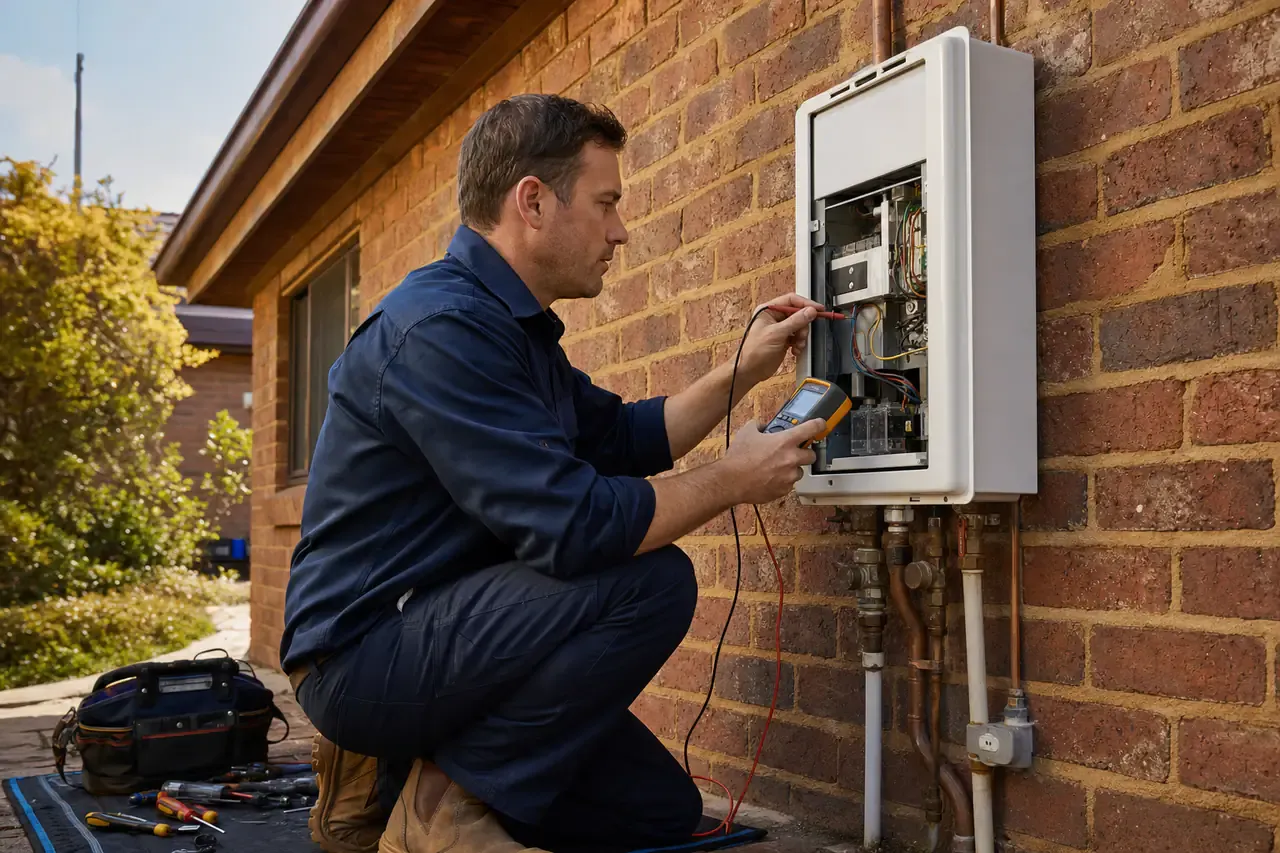
Emergency hot water repair in Sydney

It always picks the worst moment. Saturday morning before the in-laws arrive. Tuesday at 6am with a cold school run ahead. The middle of an East Coast Low when nobody’s leaving the house anyway. Hot water systems have a knack for failing at peak inconvenience.

The good news: most hot water emergencies in Sydney fall into a handful of common failure modes that we’ve seen hundreds of times. Roughly two-thirds of our emergency hot water calls get fixed in the first visit with parts already on the van. The remaining third usually mean the unit itself has reached end-of-life and a replacement is the right call. Read our complete hot water system failure guide to understand the four unit types and their common failure modes.

What’s actually wrong with your hot water
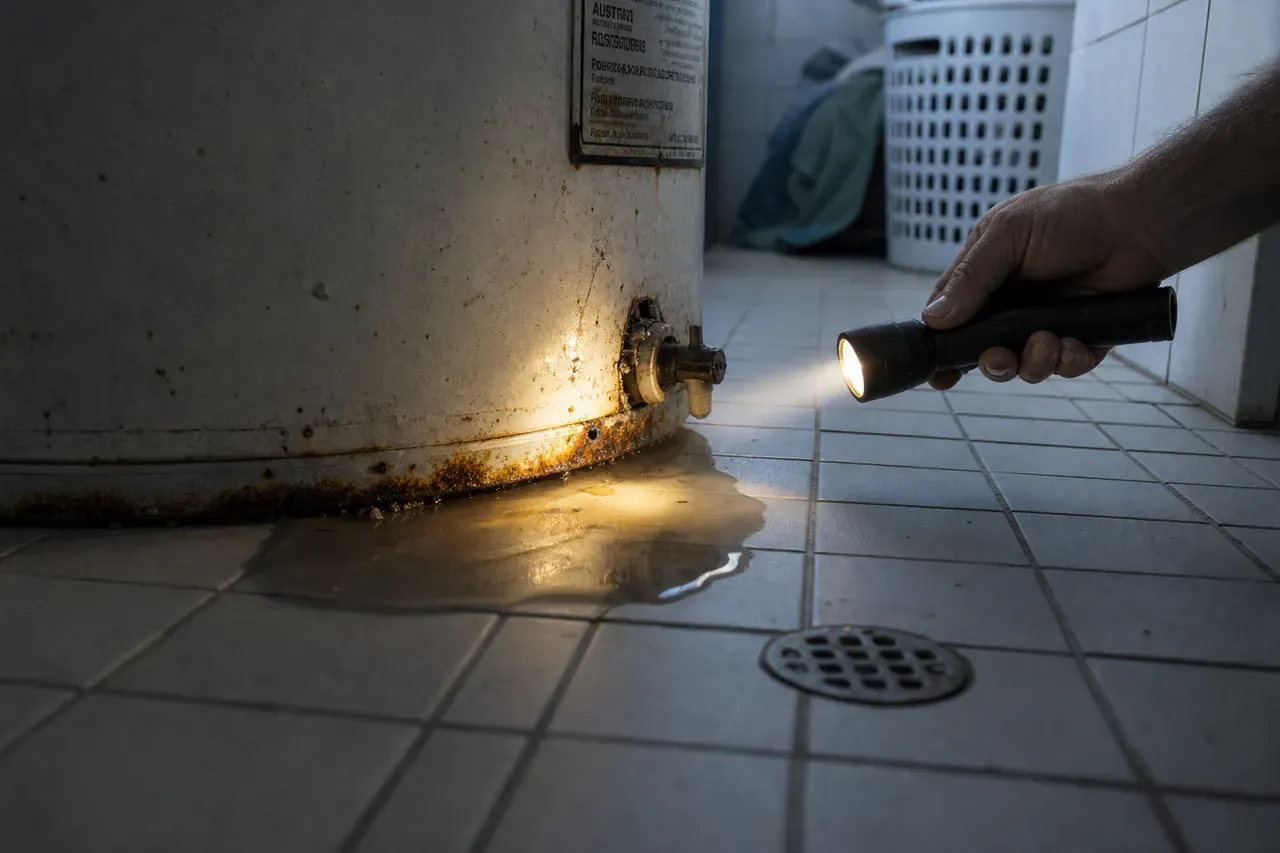
Torch showing water leaking from the base of a hot water system

Five failure patterns cover most of what we attend across Sydney.

Element burnout (electric storage units). The heating element inside the tank fails — usually after 6-10 years of service. Symptoms: water goes lukewarm and stays that way, or fully cold. Cheap repair: replacement element plus thermostat, typically $200-400 done in 60-90 minutes.

Thermostat failure (electric storage). The thermostat that controls the element gives out. Same symptoms as element burnout but cheaper to fix. Worth diagnosing properly before replacing the element — we’ve swapped plenty of perfectly good elements because the actual fault was a $40 thermostat that took 5 minutes to replace.

Gas valve or control board failure (gas instantaneous). Continuous- flow gas units (Rinnai and Rheem dominate this category in Sydney) rely on a gas valve and electronic control board to fire on demand. When either fails, the pilot won’t stay lit, the burner won’t ignite when you open a hot tap, or the unit cycles on and off without heating properly. Repair is moderate ($350-650) and usually done same visit if the right control board is in stock.

Pressure relief valve failure (storage units). The PRV is a safety component that releases water if tank pressure or temperature gets too high. When it sticks open, water continuously dribbles from the overflow pipe; when it sticks shut, you’ve got a real safety problem. Replacement is straightforward — typically $220-380 — and required under NSW compliance regulations on any storage tank. Installation requirements follow the Plumbing Code of Australia.

Tank rust-through (electric and gas storage, end-of-life). The tank itself fails — water through the cladding, water on the floor, no amount of repair will fix it. Storage tanks are designed for 8-12 years; coastal-zone units often fail sooner. The only option is replacement. We quote like-for-like (Rheem to Rheem, Rinnai to Rinnai) or heat-pump upgrade with a clear payback calculation.

Why Sydney’s hot water systems fail differently
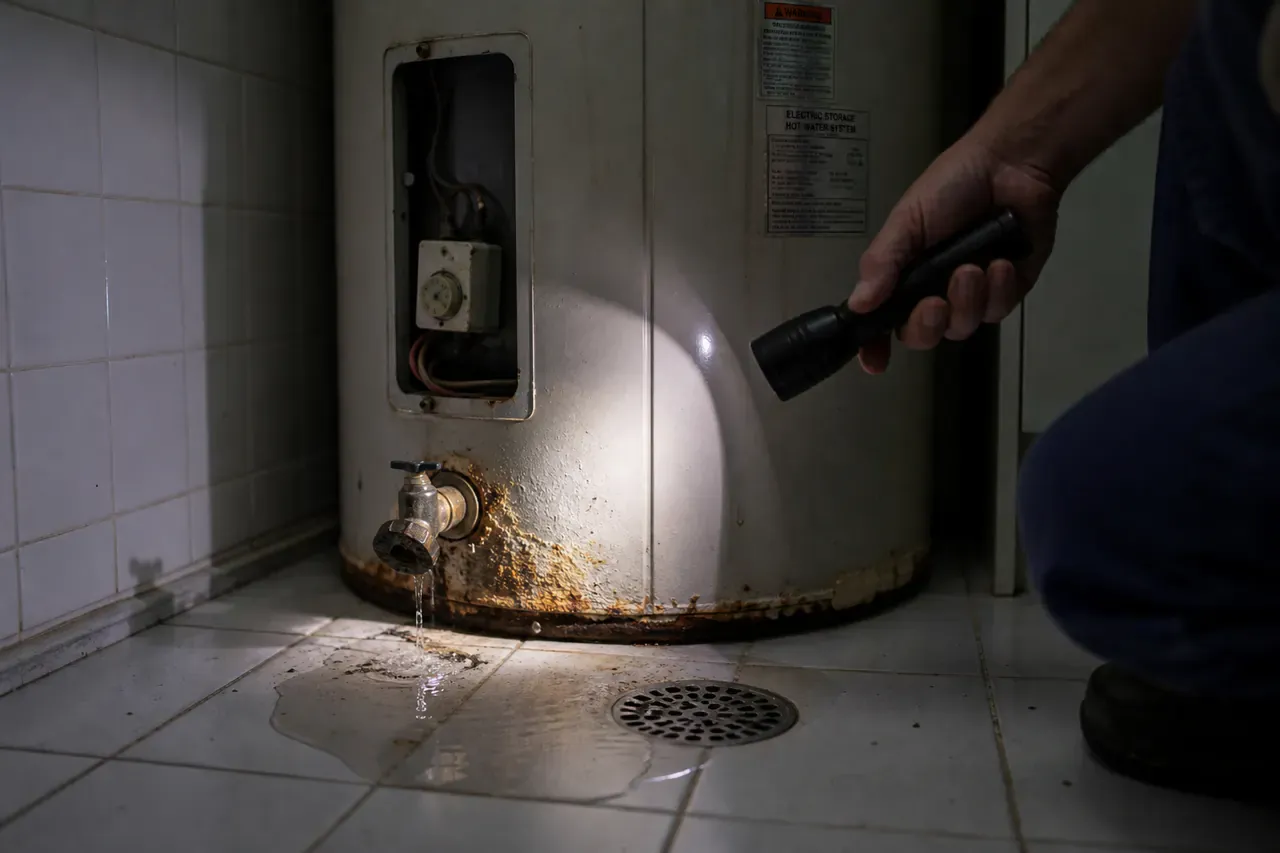
Corroded valve leaking at the base of a hot water tank

A few regional patterns show up over and over.

Coastal corrosion — Eastern Suburbs and Northern Beaches. Salt- laden air pits the outer cladding and external fittings. Within 8-10 years, even premium units (Rheem Enviro, Rinnai INFINITY) show visible corrosion at every fitting and valve. It is worst close to the ocean: Bondi, Coogee, Manly and Mona Vale. Marine-grade fittings on replacement install extend service life noticeably.

Sediment build-up — everywhere, slowly. Sydney’s water is soft, so scale is not the problem it is in some other cities, but every storage tank collects sediment at the bottom over the years. It covers the element, makes the unit noisy and shortens its life. Flushing the tank (about $120-180) every few years helps.

Strata high-rise complications — CBD, Pyrmont, Surry Hills, Bondi Junction. Apartment hot water systems are typically smaller capacity than free-standing house units and often shared across multiple lots in older builds. Replacement requires body corporate sign-off and sometimes specialist access (cranes for top-floor instantaneous units). We’ve done all of it; not a barrier.

Heritage-home installations — Inner West, Eastern Suburbs heritage zones. Installing a modern hot water unit in a Federation or Victorian terrace sometimes needs creative fitting work where the original plumbing wasn’t designed for current standards. Worth getting a specialist quote rather than the cheapest option. Plumber licences can be checked through NSW Fair Trading.

Rheem and Rinnai: what to check before the repair

Both Rheem (Australia’s largest hot water manufacturer) and Rinnai (the gas instantaneous specialist) operate authorised service agent networks in Sydney. Practical implications:

  • Warranty repairs on a unit still under manufacturer warranty are covered when performed by an authorised agent — tell the plumber the unit’s age and brand when they confirm the quote so the warranty isn’t put at risk
  • Genuine parts rather than aftermarket equivalents that cause secondary failures — ask what is being fitted
  • Compliance certificates issued by the licensed plumber where required (gas connections, AS/NZS 3500 compliance for replacements)

If your existing unit is Bosch, Dux, AquaMAX or another brand, we still service them — just confirm the brand on your quote form so we can check parts availability before dispatch.

Repair, replace, or upgrade?
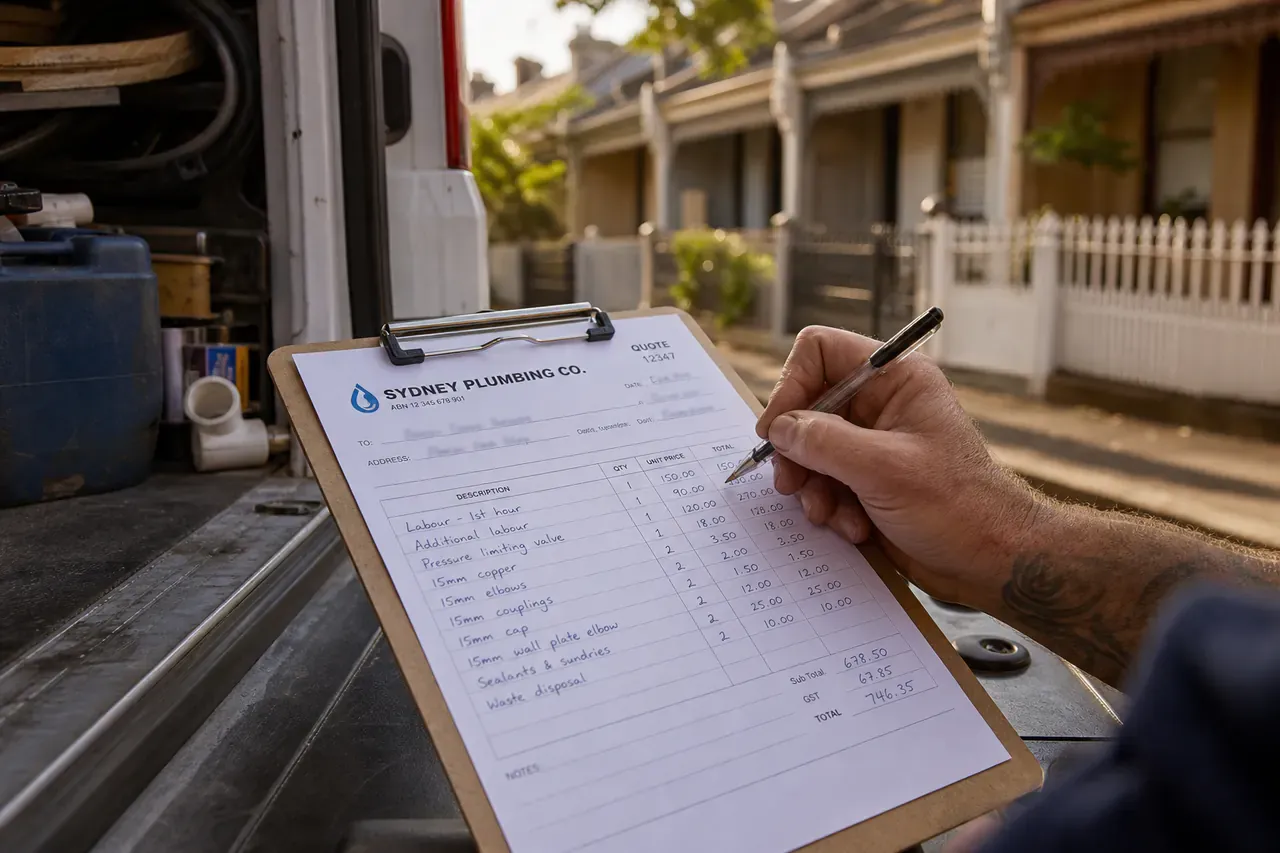
Plumber writing an itemised quote on a clipboard

The decision tree we walk customers through:

Repair if: unit is under 8 years old, the fault is parts-replaceable, total repair cost is less than 30% of replacement cost. Almost always the right call for the next 3-5 years.

Replace like-for-like if: unit is 8-12 years old, recent failures have been frequent or expensive, your usage pattern hasn’t changed. Predictable cost, predictable performance, predictable lifespan.

Upgrade to heat pump if: unit is over 10 years old, you’re open to higher upfront cost for lower running costs, you qualify for NSW Energy Savings Scheme rebates (most Sydney households do). Payback typically 4-7 years. Quieter, more efficient, future-proofed against gas phase-out announcements.

We quote all three options when relevant so you can decide with full numbers in front of you, not under emergency pressure.

What about gov rebates?

The NSW Energy Savings Scheme provides incentives for upgrading inefficient water heating systems — primarily heat pump systems replacing electric storage. Rebates typically range $500-$1,500 depending on the unit and household circumstances. We handle the paperwork as part of the install if you go that route; you don’t fill in anything yourself.

There’s also a Federal Small-scale Technology Certificate (STC) scheme that applies to heat pump installs. Worth $300-800 in additional rebate value, also handled as part of the quote.

Combined, the rebates often bring the upfront cost of a heat pump install close to the cost of a like-for-like electric storage replacement. Worth asking about during the quote.

What you can check while you wait

If you’ve submitted the quote form and a plumber’s on the way, three quick checks that might save the call-out entirely:

  1. Check the circuit breaker for the hot water system in your main switchboard. Sometimes a power surge trips the breaker; flicking it back on solves the problem.
  2. Check the gas supply if you’ve got an instantaneous gas unit — look at the gas meter outside, make sure the valve handle is parallel to the pipe (open). Sometimes maintenance crews shut it off and forget to re-open.
  3. Check for an obvious leak around the base of the unit. Water on the floor of a storage tank means tank failure (replacement, not repair). Water dripping from the overflow pipe means a stuck pressure relief valve (repair, not replacement).

If any of those resolves it, ring us back and we’ll cancel the dispatch with no charge. If not, we’re already on the way.

For cost guidance before we arrive, see our full emergency plumber pricing guide with exact Sydney 2026 ranges for every hot water repair and replacement scenario.

Our process

From quote to repair — four clear steps

Repair workflow

Emergency Hot Water Repair Sydney

  1. 1

    Step 1

    Diagnose on arrival

    Most hot water failures fall into a few common categories. We can usually identify the issue inside 15 minutes of arrival.

  2. 2

    Step 2

    Quote repair vs replace

    If the system is under 10 years old and the fault is parts-replaceable, repair is almost always cheaper. If it's older or the tank itself has failed, we quote a replacement at the same time.

  3. 3

    Step 3

    Same-day fix where possible

    Common parts (thermostats, elements, gas valves, pressure relief valves) are on the van. Most repairs completed in the first visit.

  4. 4

    Step 4

    Replace within 24 hours if needed

    Like-for-like replacements (Rheem-to-Rheem, Rinnai-to-Rinnai) usually scheduled inside 24 hours. We dispose of the old unit and commission the new one.

Every job is quoted and carried out by a licensed local plumber · Ask them about their workmanship guarantee before work starts

Real Sydney rates

What you can expect to pay

Honest pricing based on actual Sydney market rates. Final quote always confirmed in writing before any work begins — no hidden call-out tricks.

Job typeSydney range (AUD)
Diagnostic call-out$120-180
Element or thermostat replacement$200-400
Gas valve / control board replacement$350-650
Pressure relief valve / TMV replacement$220-380
Like-for-like electric storage replacement$1,200-2,200
Like-for-like gas instantaneous replacement$1,800-3,500
Heat pump system install (premium upgrade)$3,500-5,500

Ranges reflect typical Sydney metropolitan area pricing for 2026. Standard hourly: AUD 120-160. After hours / weekends: AUD 180-300.

Where we cover

Emergency Hot Water Repair Sydney — by Sydney area

Same service, same prices, all Sydney metropolitan suburbs. Some regions have local quirks worth knowing about — tap your area below.

Common questions

Emergency Hot Water Repair Sydney — your questions answered

  • How fast can you get hot water back on?
    Most repairs are completed inside 90 minutes of arrival — element and thermostat changes are quick once the unit's isolated and drained. Replacements are scheduled within 24 hours where like-for-like stock is available, which it usually is for Rheem and Rinnai units. Bosch and other brands sometimes need a 48-hour parts order.
  • Repair or replace? How do I decide?
    Rule of thumb: if the unit is under 8 years old and the fault is parts-replaceable, repair is almost always cheaper over the next 5 years. If the unit is over 12 years old, replacement usually makes more sense — the warranty has expired, efficiency has degraded, and the next failure is around the corner. We quote both at the same time so you can decide with full numbers in front of you.
  • What's the difference between Rheem and Rinnai?
    Both are top-tier Australian-market brands with strong dealer networks. Rheem dominates electric and gas storage in Sydney; Rinnai dominates gas instantaneous (continuous flow). Most homes are on whichever was original at install. If your unit is still under manufacturer warranty, tell the plumber when they confirm the quote so warranty work is handled the right way.
  • My hot water smells like rotten eggs — is it dangerous?
    Annoying, not dangerous. The smell is hydrogen sulphide gas produced by bacteria in the tank reacting with the sacrificial anode (a magnesium rod inside the tank that prevents the steel from corroding). Replacing the anode usually fixes it permanently — about $250-350 including parts. Worth doing every 5 years anyway as preventative maintenance.
  • Do you do heat pumps?
    Yes — heat pump installs and repairs are growing fast across Sydney since the NSW Energy Savings Scheme rebates kicked in. We can quote like-for-like replacements (electric storage to heat pump) and walk you through the rebate paperwork. Payback period in Sydney is typically 4-7 years on energy savings alone.
  • What about salt corrosion on my coastal hot water unit?
    Real problem in Bondi, Coogee, Manly, and the Northern Beaches. Salt-laden air pits the outer cladding and external fittings within 8-10 years even on premium units. Worth replacing exposed copper fittings with stainless equivalents at the next service. Ask for marine-grade fittings on any coastal install.
  • Can I just replace it myself?
    Not legally in NSW. Hot water installations involve gas connections (instantaneous units) or 240V electrical (storage units), both of which require licensed tradespeople under NSW law. DIY installs void the manufacturer warranty, void your home insurance, and create real safety hazards. Licensed install is also a requirement for any gov rebate paperwork.

First five minutes

What to Do Right Now, Before the Plumber Arrives

Pick what is happening. These are the safe first steps to take in the next five minutes, before the plumber arrives.

Burst or leaking pipe: what to do now

Stop the water first, then deal with the mess.

  1. Turn the water off at the meter. It is usually in a box near your front boundary. Turn the tap clockwise, or turn the lever a quarter-turn so it sits across the pipe. In a unit, look for the isolation tap under the kitchen sink, in the laundry or in the bathroom.
  2. Keep water away from electricity. If water is near power points, lights or appliances, switch the power off at the switchboard — but only if you can reach it without standing in water.
  3. Drain what is left in the pipes. Open a cold tap at the lowest point of the house (a garden tap is ideal) and turn the hot water system off.
  4. Limit the damage. Put buckets and towels under the leak, move furniture and valuables, and take photos for your insurer.

Don't use electrical appliances in a wet room, and don't turn the water back on to test it.

Smell of gas: what to do now

Get out first. Make every call from outside.

  1. Don't touch anything electrical. No light switches, exhaust fans or appliances, and no flames or cigarettes. A single spark can ignite gas.
  2. Turn the gas off at the meter if you can reach it safely. The gas is off when the handle sits across the pipe.
  3. Open doors and windows and get everyone outside. Pets too. Stay out until you are told it is safe.
  4. From outside, ring Jemena on 131 909. That is the gas network's 24/7 faults and emergencies line for Sydney. If anyone feels unwell or there is a fire, ring 000. Ring Jemena: 131 909
  5. Then call a licensed gasfitter. The network crew makes the supply safe. Finding and repairing a leak on your side of the meter is a gasfitter's job.

Don't go back inside to look for the leak, and don't relight pilot lights yourself.

Sewage or drains backing up: what to do now

Every litre you send down the drain comes back up.

  1. Stop running water. No flushing, taps, showers, washing machine or dishwasher until the blockage is cleared.
  2. Keep people and pets away. Sewage is a health hazard. Wear gloves and wash well if you have to touch anything.
  3. Check the overflow gully outside. It is the grated drain against the wall near the laundry or kitchen. Clear pot plants and leaves off it, so any overflow happens outside and not through your floor drains.
  4. Ask next door. If the neighbours have the same problem, or sewage is coming up in the street, the blockage may be in the Sydney Water main. Report it on 13 20 90. Ring Sydney Water: 13 20 90

Don't pour chemical drain cleaner into a blocked drain. It rarely clears a sewer blockage, and it is dangerous for whoever opens the pipe next.

No hot water or leaking tank: what to do now

A leaking tank is urgent. A cold shower can usually be fixed the same day.

  1. Leaking tank? Turn off its water supply. Close the tap on the cold-water pipe going into the unit.
  2. Turn off its power or gas. Electric: switch off the hot water circuit at the switchboard. Gas: close the gas tap on the pipe to the unit.
  3. No leak, just cold? Electric: check whether the hot water breaker has tripped. Gas: check that your other gas appliances work and whether the pilot light is out — relight it only by following the instructions printed on the unit.
  4. Read the label. Note the brand, model and size printed on the tank. It lets us quote a repair or a replacement before we arrive.

Don't block or cap the relief valve that drips from the side of the tank. It is a safety device.

Overflowing or blocked toilet: what to do now

Stop the water going in before you do anything else.

  1. Turn off the tap behind the toilet. It is the small tap on the wall or floor beside the cistern. Turn it clockwise.
  2. Don't flush again. If the bowl is still filling, lift the cistern lid and push the rubber flapper down, or lift the float.
  3. Mop up straight away. In a unit, tell the building manager if water may reach the apartment below.
  4. Check the other drains. If the shower or floor drain gurgles or backs up as well, the blockage is in the sewer line — follow the sewage steps.

Don't keep plunging once water reaches the rim, and don't use chemical cleaners.

General guidance only. If anyone is in danger, ring 000.

Need a emergency hot water repair sydney now?

Get a free Sydney quote in under 60 seconds.

Licensed local Sydney plumbers are on call 24/7. Tell us your suburb and a local plumber replies with a quote and an ETA as soon as one is available.

Prefer to talk? Call 0468 022 662 — 24/7

Call now Free quote