
Skip to content

Sydney Emergency Plumbing

Emergency Toilet Repair Sydney

Overflowing pans, cracked cisterns, blocked S-bends, leaking seals — licensed local plumbers with Caroma parts on the van. Most repairs completed in 30-60 minutes.

Call 0468 022 662 Get a free quote
  • Caroma flush valves, fill valves, and cistern internals on every van
  • Toilet pan removal and reseating (broken wax/silicone seals)
  • Cracked or split cistern replacement (like-for-like sizing)
  • S-bend and toilet trap clearance using mechanical and pressure methods
  • Licensed local plumbers
  • Direct contact
  • 24/7
  • Free quotes

Free quote: Emergency Toilet Repair

Australian format - used to reply about your quote.
Add brief description (optional)
How urgent?

Free, no obligation. We reply as soon as a plumber is available. Privacy.

Emergency Toilet Repair Sydney: the short answer

Most emergency toilet repairs in Sydney cost $220-380 for new cistern parts, and a like-for-like replacement of the whole toilet costs $850-1,800. If the toilet is overflowing, turn off the tap beside the cistern and do not flush again. Our licensed plumbers attend 24 hours a day, usually within 60 minutes.

Updated 06 October 2026

What's included with every emergency toilet repair sydney

Every job includes the basics below — no surprise extras tacked on when the invoice arrives.

  • Caroma flush valves, fill valves, and cistern internals on every van
  • Toilet pan removal and reseating (broken wax/silicone seals)
  • Cracked or split cistern replacement (like-for-like sizing)
  • S-bend and toilet trap clearance using mechanical and pressure methods
  • Inspection and repair of common-property strata waste lines
  • Old toilet disposal included — we take it away
  • Workmanship guarantee from the plumber — ask before work starts

When to ring us

Signs you've got an emergency on your hands

Not sure if it's urgent? If you're seeing any of the below in your Sydney home, don't wait — small problems become expensive ones inside hours.

  • Toilet overflowing and shut-off valve isn't stopping the flow
  • Water leaking continuously from the cistern into the pan
  • Visible crack in the cistern or pan with water seeping out
  • Strong sewer smell from a toilet that won't go away after flushing
  • Toilet flushes but doesn't fully clear — paper or waste left behind
  • Multiple flushes needed every time
  • Wobbly toilet pan that rocks when sat on

How we fix it

About this service in Sydney
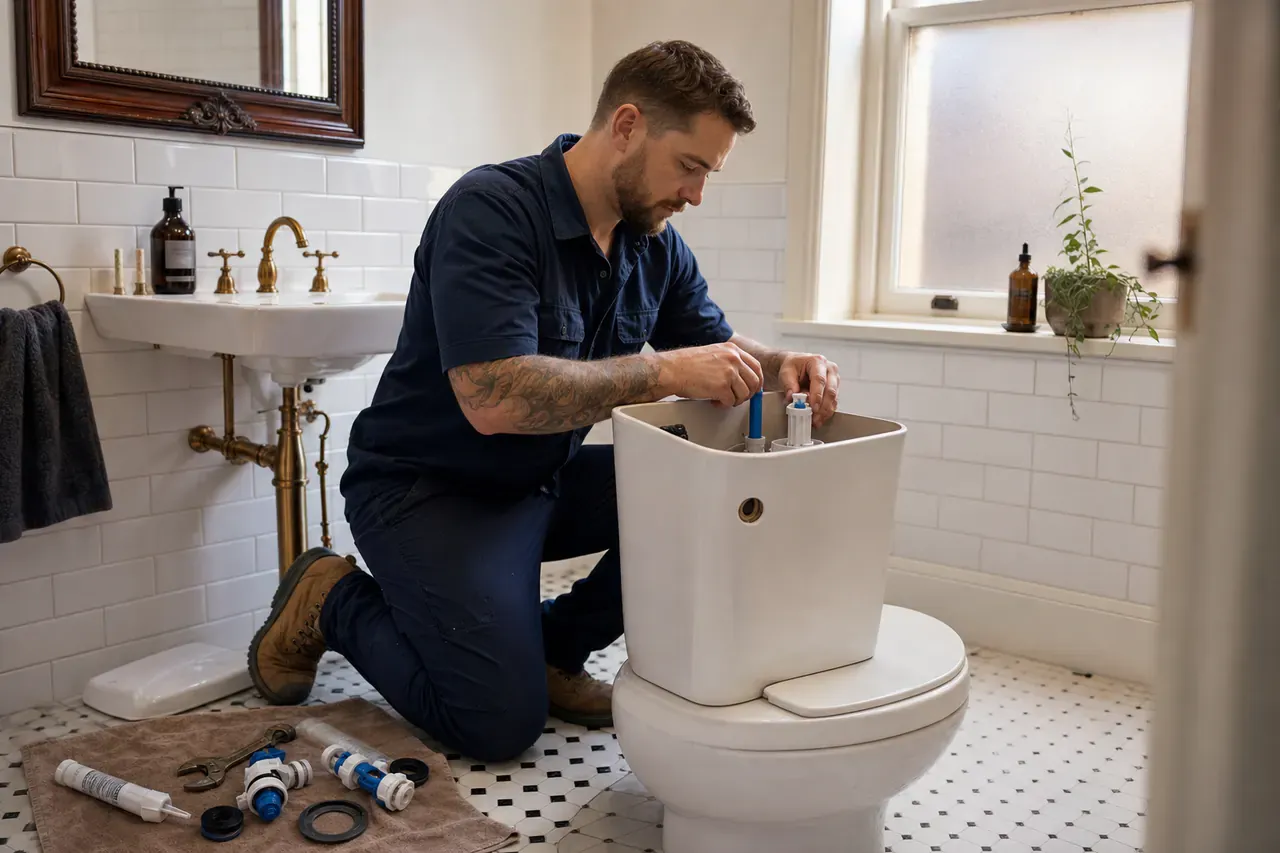
Emergency toilet repair in Sydney

Toilet emergencies are the underrated category. They’re not as dramatic as a burst pipe or as scary as a gas leak, but a toilet that’s overflowing, leaking, or refuses to flush at the wrong moment brings a household to a halt fast. Particularly if it’s the only one in the house.

The good news: about 80% of toilet repair calls we attend across Sydney are quick fixes — cistern internals, seals, S-bend blockages — completed in 30-60 minutes with Caroma parts already on the van. The remaining 20% are bigger jobs (cracked pans, full replacements, common-waste issues in strata buildings) but still straightforward once diagnosed.

Caroma — why one brand dominates Sydney

Walk into almost any Sydney bathroom built or renovated since the late 1980s and you’ll find a Caroma cistern. The Australian-made brand has held the dominant market share for decades, partly through quality, partly through the strength of its dual-flush patent (Caroma invented the modern dual-flush toilet in 1980 — genuinely significant Australian engineering history).

Practical implications when something fails:

  • Replacement parts are stocked at every plumbing supplier in the Sydney metro and on every emergency van we run
  • Standard fittings mean a Caroma flush valve from 1995 is largely interchangeable with a Caroma flush valve from 2025
  • Like-for-like replacements are quick to source and predictable in cost — no waiting on imported parts

If you’ve got a non-Caroma toilet (Roca, Posh, Stylus, Geberit, or imported European units), repairs are still doable but sometimes involve a 24-48 hour parts wait. We’ll tell you upfront whether that’s the case.

What’s actually breaking on your Sydney toilet
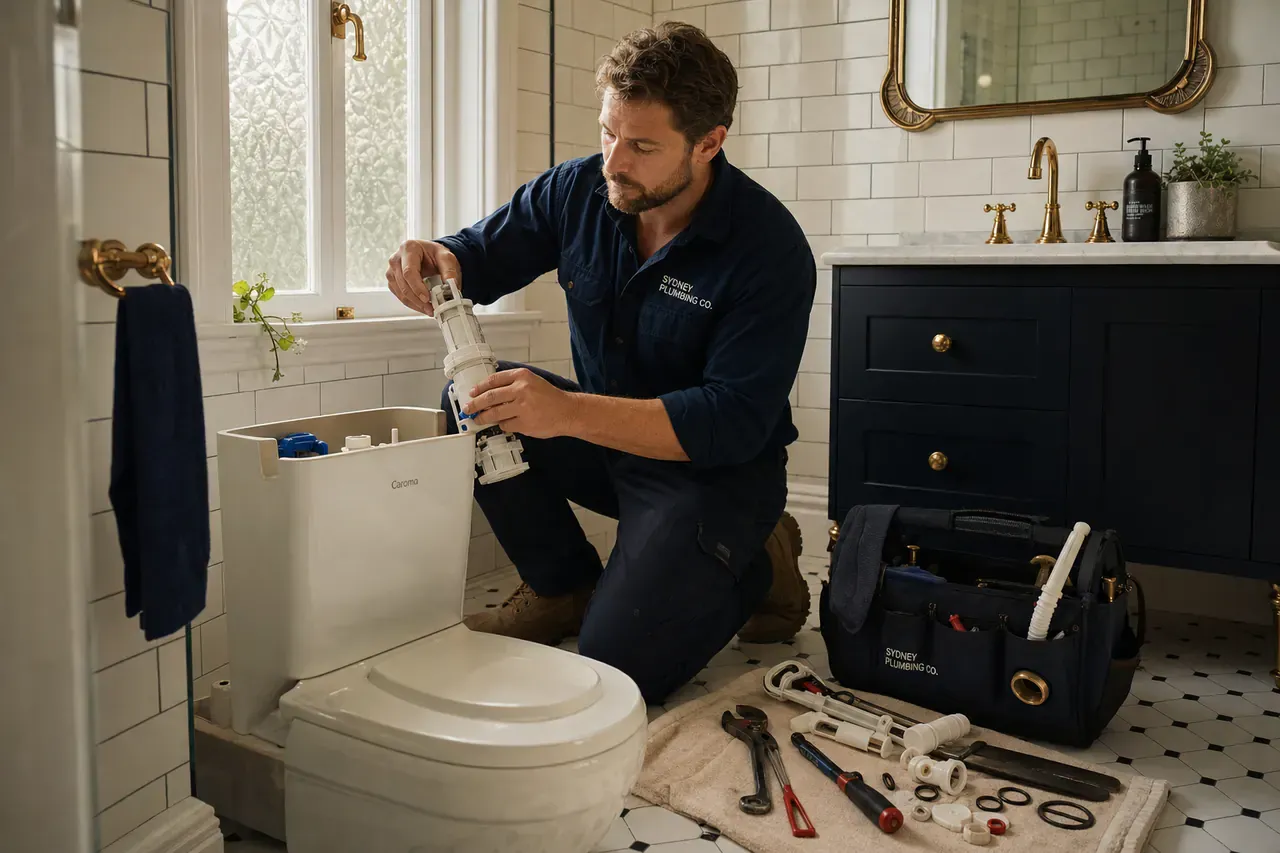
Plumber replacing the parts inside a toilet cistern

Five failure patterns cover most of what we attend.

Flush valve failure (cistern internals). The single most common toilet emergency. The flush valve (the rubber-and-plastic mechanism that releases water from the cistern into the pan when you press the button) wears out — usually after 10-15 years of service. Symptoms: weak flush, partial flush, continuous water trickle from the cistern into the pan. Cheap repair: $220-380 done in 30-45 minutes with stock Caroma parts.

Fill valve failure (cistern internals). The fill valve refills the cistern after each flush. When it fails, the cistern either won’t fill (no water for next flush), overfills (water running constantly through the overflow into the pan), or fills slowly (extended re-fill times). Same repair cost band as flush valve — often we replace both at once if the unit is older than 10 years because the second failure is usually months away.

Seal failure at the base (wax or silicone). The toilet pan sits on a wax ring or silicone gasket that seals the connection between the pan and the floor flange. Over time the seal degrades, allowing small water and waste seepage into the floor cavity below. Symptoms: wobbly pan, sewer smell that won’t clear after flushing, damp patch on the floor around the base. Repair requires lifting the pan, replacing the seal, reseating — typically $280-450 for the job.

Cracked cistern or pan. Porcelain damage from impact (a mishandled cleaning brush, kids climbing on the cistern lid), thermal stress (rare, but happens with extreme cold snaps in Western Sydney), or simple age fatigue. Replacement is the only viable option once porcelain cracks. Like-for-like Caroma replacement runs $450-850 for cistern only, $850-1,800 for full pan and cistern.

S-bend blockage. The S-bend (the curved trap built into the toilet base) collects paper, hair, and any foreign objects flushed accidentally. Most clear with mechanical hand auger from the pan side. Stubborn blockages occasionally require lifting the pan to access from below — adds about $150 to the repair cost.

Sydney-specific toilet quirks
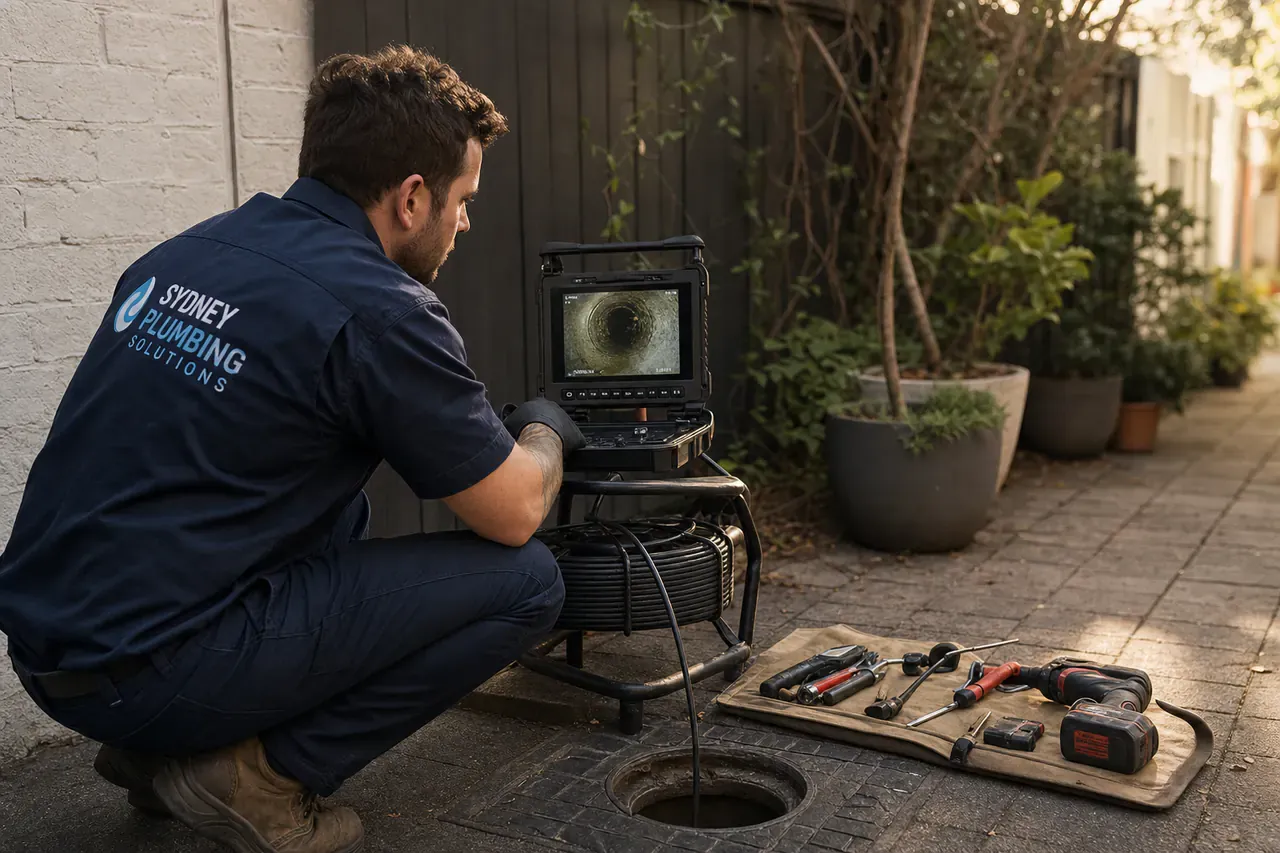
Plumber checking the sewer line with a CCTV drain camera

A few patterns worth knowing about.

Heritage homes (Newtown, Glebe, Paddington, Balmain, Surry Hills) often have toilets installed when the bathroom was retrofitted into what was originally an external WC — meaning the soil pipe runs in unusual locations and the floor flange isn’t always where you’d expect. Replacement work sometimes needs creative fitting.

Strata buildings (CBD, Pyrmont, Bondi, Mascot) share waste risers between multiple lots stacked vertically. A blockage at your unit can have its actual cause two floors above; a blockage in someone else’s unit can affect yours. CCTV documentation is gold for sorting out the body corporate vs lot owner cost split.

Apartment in-wall cisterns (post-2010 builds in Pyrmont, Surry Hills, Bondi Junction) hide the cistern inside the wall behind the toilet pan. Repairs require accessing through a removable wall panel, which sometimes adds to labour cost but is otherwise standard work.

Older 11L single-flush toilets in pre-1990 homes use considerably more water per flush than modern dual-flush units. Replacement to a modern 4.5/3L dual-flush typically pays for itself in water bill savings within 5-7 years for a household of four. Worth considering during any major repair.

Repair vs replace — when each makes sense

Most calls we attend are repair scenarios. The decision tree:

Repair if the cistern internals are the only issue, the porcelain is intact, the seal is fine, and the unit is under 15 years old. Total repair cost typically $220-450 covering the next 5+ years of service.

Replace if the porcelain itself is damaged (crack in the pan or cistern), the unit has had three or more failures in the last two years (the next failure is around the corner), or you’re already renovating the bathroom and the timing makes sense.

Upgrade if you’ve got an older single-flush unit using 11L per flush — the water bill savings from a modern 4.5/3L dual-flush typically justify the upgrade cost within 5-7 years for a typical household.

We quote both repair and replacement when relevant so you can decide with full numbers in front of you, not under emergency pressure. Any plumber’s licence can be checked through NSW Fair Trading.

Strata building considerations
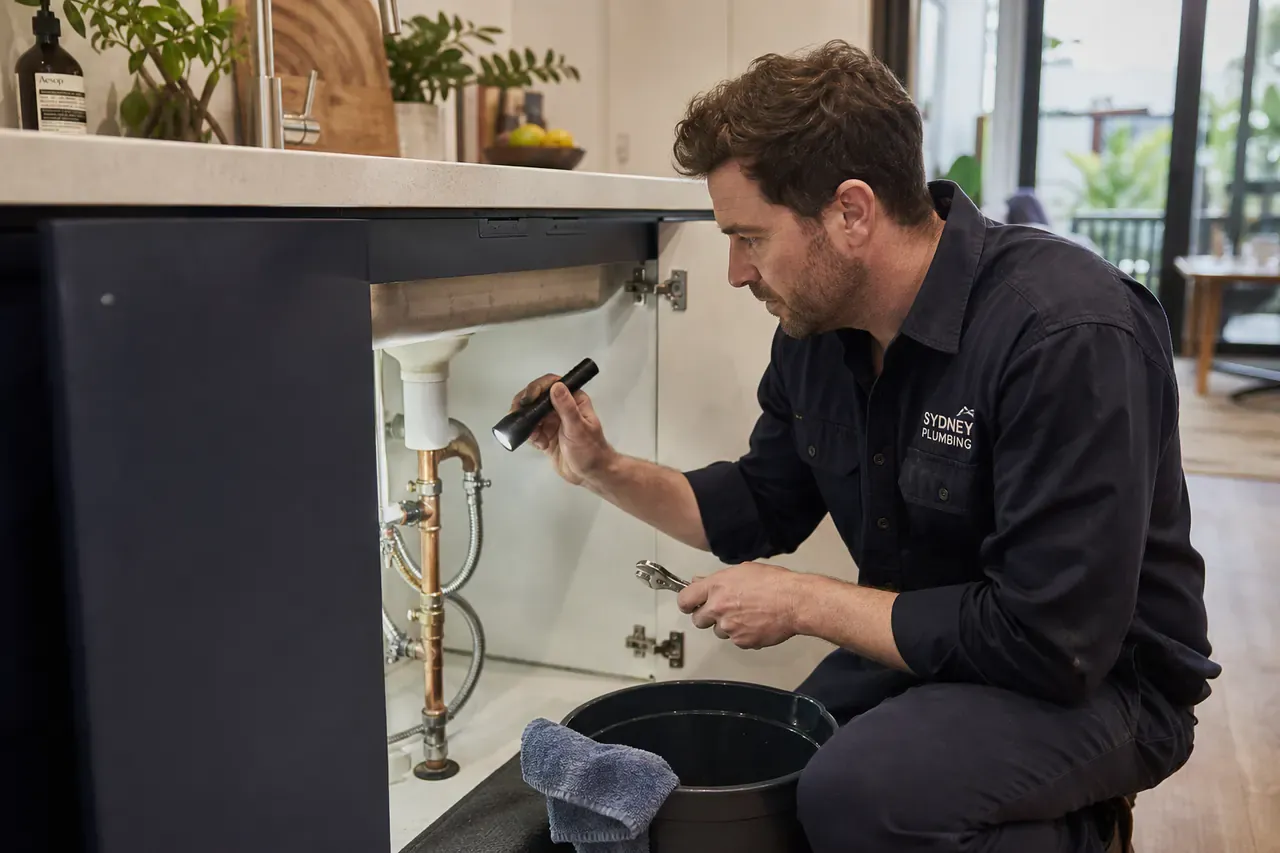
Plumber checking pipework under a sink with a torch

About a quarter of our toilet repair calls are in strata properties across the Sydney CBD, Pyrmont, Surry Hills, Bondi Junction, and similar high-density suburbs. The cost-allocation rules are usually straightforward but worth understanding:

  • Lot owner pays for the toilet itself (pan, cistern, internals, isolation valve) and the branch waste pipe up to the common-property riser
  • Body corporate pays for the common-property waste riser, the building’s main soil stack, and the connection to the street sewer
  • Ambiguous cases (a blockage where the cause is downstream of your apartment but upstream of the riser) generally fall to the body corporate but sometimes need CCTV documentation to confirm

We provide itemised invoices that make the split obvious. Sydney Water sets out which pipes are the owner’s responsibility and which are the utility’s. For larger strata jobs (riser blockages affecting multiple lots), we can liaise directly with your strata manager from initial diagnosis through to job completion.

What you can do while you wait

If you’ve submitted the quote form and a plumber’s on the way:

  1. Shut off the cistern isolation valve — small chrome valve behind the toilet, turn clockwise. Stops further water entering the cistern while we’re on the road.
  2. If the toilet is overflowing, lift the cistern lid and push the float arm up to break the fill cycle. Then shut off at the wall.
  3. Don’t use the toilet in the meantime — even if it’s still “working” partially, repeated use can worsen blockages or push damaged seals further.
  4. Move toilet paper, towels, and bath mats out of the immediate area if there’s any standing water — saves cleanup later.

Most Sydney toilet emergencies look worse than they are. A flush valve replacement costs about as much as a tank of fuel and takes less time than ordering pizza. Ring us, we’ll be there.

If overflow water has reached the floor or cabinetry, also read our burst pipe and water damage insurance guide — toilet overflow damage is often covered under your home policy. For pricing expectations, see our Sydney plumbing cost guide.

Our process

From quote to repair — four clear steps

Repair workflow

Emergency Toilet Repair Sydney

  1. 1

    Step 1

    Isolate and assess

    Shut off the cistern fill valve at the wall. Identify whether the issue is internal (cistern parts), external (seal/pan), or downstream (S-bend blockage).

  2. 2

    Step 2

    Quote in writing

    Repair vs replace decision laid out with parts and labour pricing. Most calls fall into a $200-450 repair window.

  3. 3

    Step 3

    Repair with Caroma stock

    Caroma is the dominant brand across Sydney. We carry common Caroma flush valves, fill valves, seals, and cistern internals.

  4. 4

    Step 4

    Test and clean up

    Multiple flush cycles to verify the repair, leak-test around all seals, area cleaned, old parts taken away.

Every job is quoted and carried out by a licensed local plumber · Ask them about their workmanship guarantee before work starts

Real Sydney rates

What you can expect to pay

Honest pricing based on actual Sydney market rates. Final quote always confirmed in writing before any work begins — no hidden call-out tricks.

Job typeSydney range (AUD)
Cistern internals (flush/fill valve replacement)$220-380
Toilet seal replacement (wax/silicone)$280-450
Cracked cistern replacement (like-for-like)$450-850
Full toilet replacement (pan + cistern)$850-1,800
S-bend / trap clearance$180-350
Strata common-waste investigation$280-550

Ranges reflect typical Sydney metropolitan area pricing for 2026. Standard hourly: AUD 120-160. After hours / weekends: AUD 180-300.

Where we cover

Emergency Toilet Repair Sydney — by Sydney area

Same service, same prices, all Sydney metropolitan suburbs. Some regions have local quirks worth knowing about — tap your area below.

Common questions

Emergency Toilet Repair Sydney — your questions answered

  • My toilet is overflowing right now — what do I do?
    Lift the cistern lid and push the float arm up — that stops the fill valve and breaks the cycle. Then turn the isolation valve at the wall behind the toilet (usually a small chrome handle) clockwise to shut off water supply. Mop up what's there, ring us, and we'll be on the way. Most overflows are a stuck float or failed flush valve — quick repair.
  • Caroma versus other brands — does it matter what's in my house?
    Caroma dominates the Australian market and is what we carry as standard stock. If you've got a Roca, Posh, Stylus, or imported unit, repairs are still doable — we either source the matching part (24-48 hours) or recommend a like-for-like replacement using Caroma equivalent fittings. Most domestic toilets in Sydney homes built since 1990 are Caroma.
  • When is replacement cheaper than repair?
    Once the pan or cistern itself cracks, repair generally isn't viable — porcelain doesn't take to patching. If you've got a 15+ year old unit with multiple recent failures (flush valve, fill valve, seal all gone), the labour cost of three separate repairs often exceeds the cost of a like-for-like replacement. We quote both options when relevant.
  • Can a toilet S-bend really block?
    Yes, particularly in older homes with original 1970s/80s pans where the S-bend geometry is tighter than modern designs. Hair, paper buildup, kids' toys, and (in apartment blocks) wet wipes from upstream all cause classic S-bend blockages. Mechanical clearance from the pan side usually fixes it; occasionally we need to lift the pan to clear from below.
  • Why does my toilet smell even after flushing?
    Three common causes. Failed wax or silicone seal at the base lets sewer gas escape from the soil pipe. Faulty cistern outlet valve allowing slow leaks past the flap. Or biofilm buildup inside the rim and trapway that traps odour. We diagnose by smell location and visible inspection — fix is usually in the $250-450 range depending on which cause.
  • Toilet wobbles when I sit on it. Big problem?
    Could be. A wobbly toilet usually means the seal at the base has failed or the floor flange (the bracket that secures the pan to the floor) is cracked or corroded. Both let waste water seep into the floor cavity over time, eventually rotting the substrate. Worth fixing inside a week or two — not necessarily an overnight emergency, but not something to leave for months.
  • Strata building — who pays for the repair?
    Generally: anything inside your apartment (the toilet itself, the in-wall cistern, your branch waste pipe) is your cost as the lot owner. Anything in the common property — shared waste risers, the soil stack, the building's main drainage — is the body corporate's cost. We supply itemised invoices that make the cost split obvious for both parties. For ambiguous cases (a blockage where the cause is downstream of your apartment), CCTV documentation usually settles it.

First five minutes

What to Do Right Now, Before the Plumber Arrives

Pick what is happening. These are the safe first steps to take in the next five minutes, before the plumber arrives.

Burst or leaking pipe: what to do now

Stop the water first, then deal with the mess.

  1. Turn the water off at the meter. It is usually in a box near your front boundary. Turn the tap clockwise, or turn the lever a quarter-turn so it sits across the pipe. In a unit, look for the isolation tap under the kitchen sink, in the laundry or in the bathroom.
  2. Keep water away from electricity. If water is near power points, lights or appliances, switch the power off at the switchboard — but only if you can reach it without standing in water.
  3. Drain what is left in the pipes. Open a cold tap at the lowest point of the house (a garden tap is ideal) and turn the hot water system off.
  4. Limit the damage. Put buckets and towels under the leak, move furniture and valuables, and take photos for your insurer.

Don't use electrical appliances in a wet room, and don't turn the water back on to test it.

Smell of gas: what to do now

Get out first. Make every call from outside.

  1. Don't touch anything electrical. No light switches, exhaust fans or appliances, and no flames or cigarettes. A single spark can ignite gas.
  2. Turn the gas off at the meter if you can reach it safely. The gas is off when the handle sits across the pipe.
  3. Open doors and windows and get everyone outside. Pets too. Stay out until you are told it is safe.
  4. From outside, ring Jemena on 131 909. That is the gas network's 24/7 faults and emergencies line for Sydney. If anyone feels unwell or there is a fire, ring 000. Ring Jemena: 131 909
  5. Then call a licensed gasfitter. The network crew makes the supply safe. Finding and repairing a leak on your side of the meter is a gasfitter's job.

Don't go back inside to look for the leak, and don't relight pilot lights yourself.

Sewage or drains backing up: what to do now

Every litre you send down the drain comes back up.

  1. Stop running water. No flushing, taps, showers, washing machine or dishwasher until the blockage is cleared.
  2. Keep people and pets away. Sewage is a health hazard. Wear gloves and wash well if you have to touch anything.
  3. Check the overflow gully outside. It is the grated drain against the wall near the laundry or kitchen. Clear pot plants and leaves off it, so any overflow happens outside and not through your floor drains.
  4. Ask next door. If the neighbours have the same problem, or sewage is coming up in the street, the blockage may be in the Sydney Water main. Report it on 13 20 90. Ring Sydney Water: 13 20 90

Don't pour chemical drain cleaner into a blocked drain. It rarely clears a sewer blockage, and it is dangerous for whoever opens the pipe next.

No hot water or leaking tank: what to do now

A leaking tank is urgent. A cold shower can usually be fixed the same day.

  1. Leaking tank? Turn off its water supply. Close the tap on the cold-water pipe going into the unit.
  2. Turn off its power or gas. Electric: switch off the hot water circuit at the switchboard. Gas: close the gas tap on the pipe to the unit.
  3. No leak, just cold? Electric: check whether the hot water breaker has tripped. Gas: check that your other gas appliances work and whether the pilot light is out — relight it only by following the instructions printed on the unit.
  4. Read the label. Note the brand, model and size printed on the tank. It lets us quote a repair or a replacement before we arrive.

Don't block or cap the relief valve that drips from the side of the tank. It is a safety device.

Overflowing or blocked toilet: what to do now

Stop the water going in before you do anything else.

  1. Turn off the tap behind the toilet. It is the small tap on the wall or floor beside the cistern. Turn it clockwise.
  2. Don't flush again. If the bowl is still filling, lift the cistern lid and push the rubber flapper down, or lift the float.
  3. Mop up straight away. In a unit, tell the building manager if water may reach the apartment below.
  4. Check the other drains. If the shower or floor drain gurgles or backs up as well, the blockage is in the sewer line — follow the sewage steps.

Don't keep plunging once water reaches the rim, and don't use chemical cleaners.

General guidance only. If anyone is in danger, ring 000.

Need a emergency toilet repair sydney now?

Get a free Sydney quote in under 60 seconds.

Licensed local Sydney plumbers are on call 24/7. Tell us your suburb and a local plumber replies with a quote and an ETA as soon as one is available.

Prefer to talk? Call 0468 022 662 — 24/7

Call now Free quote